Copper sulfide flotation reagents should be selected as a coordinated system of collectors, frothers and modifiers. Start with the copper minerals, associated sulfides and gangue, then compare candidate schemes using representative ore and process water. The objective is an acceptable balance of copper recovery, concentrate quality, froth handling and reagent consumption—not the highest response from one reagent alone.
This guide focuses on sulfide copper ores, including chalcopyrite-bearing ores. It does not prescribe a universal pH, dosage or recovery improvement. For general terminology, see what flotation reagents do.
Define the mineral and separation target first
Identify the copper minerals, their liberation and oxidation state, and their association with pyrite, other valuable sulfides and fine gangue. A chalcopyrite–pyrite separation aims to recover copper while rejecting iron sulfide. A copper–molybdenum separation can instead require depression of copper sulfides while molybdenite floats. These are different objectives and cannot share a generic “chalcopyrite depressant” recommendation.
Distinguish true mineral flotation from entrainment of fine gangue. Clay or talc-related froth problems, insufficient liberation and dissolved-ion effects can produce similar grade or recovery symptoms but need different investigations.
Copper flotation collectors: compare families, not names alone
| Collector family | Screening role | What to compare in tests |
|---|---|---|
| Xanthates | Common sulfide-collector candidates; examples include SBX, SIPX and PAX | Copper recovery, iron-sulfide recovery, consumption and response to the existing circuit chemistry |
| Dithiophosphates | Candidates for selective recovery or blends with other collectors | Performance on the actual copper minerals and associated valuables, concentrate impurities and cleaner response |
| Thionocarbamates | Candidates for selective sulfide copper collection in suitable circuits | Ore-specific selectivity, kinetics, formulation and compatibility with the current scheme |
| Dithiophosphinates | A separate collector family, including commercial products used for complex sulfide ores | The specific product’s application data and performance against the reference collector |
No family is automatically best for every copper ore. Shortlist specific products, record active content and formulation, and compare recovery–grade curves rather than a single recovery number. A blend that performs well in a rougher stage still needs cleaner-stage evaluation.
For further comparison, read xanthates versus dithiophosphates. For a product specification, review sodium butyl xanthate. Dithiophosphinates should not be described as general-purpose substitutes for cyanide depressants: collector selectivity and mineral depression are different functions.
Frothers: evaluate bubble and froth behavior
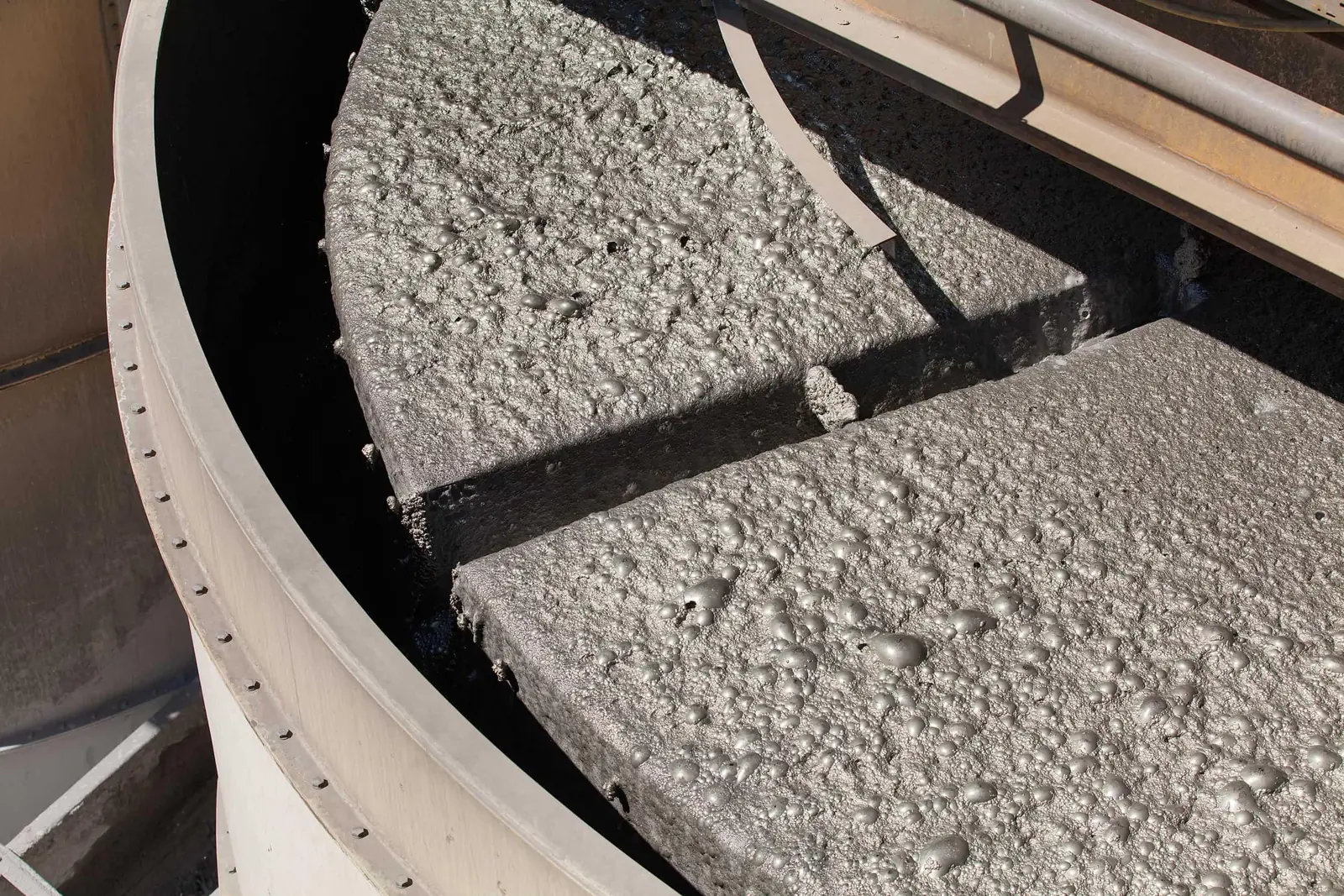
MIBC and other alcohol- or polyglycol-based frothers are candidates in sulfide flotation. Select the actual product around bubble dispersion, froth persistence, drainage, water recovery and the ability to transport mineralized bubbles through the circuit. More persistent froth is not automatically better: increased water recovery can carry unwanted fine particles into concentrate.
Test frother changes with the collector scheme and representative process water. Record air rate, froth depth and pulp conditions so an equipment or operating change is not mistaken for a reagent improvement. See the MIBC versus pine oil comparison and MIBC product information.
Depressants and pH control: specify which mineral to reject
Copper recovery with pyrite rejection
Lime and other pH-control reagents can influence sulfide selectivity. Their effect depends on collector chemistry, mineral surface condition, dissolved ions and water quality. Establish the pH range by tests; do not treat pH 10.5–11.5 as a universal optimum. Monitor copper losses as well as iron rejection.
Copper–molybdenum separation
NaHS and sodium sulfide are used in some separation schemes to depress copper sulfides while molybdenite is recovered. This is not the same duty as depressing pyrite while floating chalcopyrite. Sulfide reagents, sulfites and metabisulfite have different chemistry and should not be grouped as interchangeable oxygen-control additives.
Complex ores and organic reagents
Polymeric or organic depressants may be screened for a specific unwanted mineral, but their selectivity is not universal. Do not assume that starch, dextrin or CMC can replace cyanide in any circuit, or that a reagent is harmless because it is described as organic. Confirm performance and handling requirements for the actual formulation.
pH and oxidation–reduction potential (ORP) are useful process observations, but ORP is not a direct measurement of every mineral’s oxidation state. Record electrode and reference details, temperature and conditioning conditions when comparing results. Any change involving cyanide, sulfide reagents or acid addition requires the site’s approved compatibility and handling controls; this guide provides no such dosing procedure.
A practical reagent-selection workflow
- Define the baseline: mineralogy, liberation, grind, solids content, water chemistry, current reagents and performance.
- Shortlist candidates: compare collector families and frother products around the actual separation objective.
- Run controlled tests: record dose on a stated active- or supplied-product basis, addition order, conditioning time, pH and air conditions. Use a reference test and repeat promising results.
- Evaluate the complete balance: measure copper recovery and grade, unwanted elements, mass pull, water recovery and reagent consumption. Include cleaner performance and representative recycle conditions where relevant.
- Validate scale-up: choose addition points and staged dosing from evidence. Do not apply a fixed 60/40 split or an automatic acid, lime or copper-sulfate correction.
Information to include in a reagent inquiry
Provide the ore and target minerals, current flowsheet and reagent scheme, key test results, candidate product and active content, required quantity, packing and destination. Compare the delivered cost and consumption on a common basis, with the required TDS, current SDS and batch CoA scope.
Browse mining chemicals for product specifications or submit a supply inquiry. Product availability, documents and shipment conditions are confirmed for the offered grade and order.
Frequently asked questions
Which collectors are used for copper sulfide flotation?
Xanthates, dithiophosphates and thionocarbamates are common families to evaluate; dithiophosphinate products are also used in suitable sulfide circuits. Select a specific product using mineralogy, separation targets and representative test results.
Is a frother the same as a collector?
No. A collector promotes suitable mineral-surface hydrophobicity; a frother affects bubbles and froth behavior. Their combined effect must be evaluated with the circuit operating conditions.
What is the best pH for chalcopyrite flotation?
There is no universal best pH. The suitable range depends on associated minerals, collector chemistry, water quality and the separation objective. Establish it through tests while measuring both recovery and concentrate quality.
Do chalcopyrite depressants always improve copper recovery?
No. A reagent that depresses chalcopyrite can reduce its recovery to the froth. That may be intentional in copper–molybdenum separation, but differs from pyrite rejection during copper recovery. Identify the mineral to be depressed first.