Flotation reagents are chemicals added to mineral flotation to control which particles attach to air bubbles and which remain in the pulp. Collectors change mineral-surface wettability, frothers influence bubbles and froth, and modifiers adjust the conditions that make separation selective. This article explains the mechanism; the exact reagent scheme must be tested on the ore being processed.
When an oxide ore needs a sulfidizing step
Collectors designed for sulfide minerals may not adsorb effectively on an oxidized surface. A controlled sulfidizing step using sodium sulfide or NaHS can modify that surface before collector addition. The correct reagent and dosage are ore-specific; use the sulfidization flotation guide as a test-planning reference rather than a fixed recipe.
What are flotation reagents?
In mineral processing, flotation separates particles according to their surface behavior in water. A particle that attaches to an air bubble can rise into the froth; a particle that does not attach generally remains in the pulp. Flotation reagents alter mineral surfaces, the air–water interface or the pulp environment so that the desired separation is possible. “Flotation reagent” describes a function in a circuit, not one chemical formula or one universal product.
This page concerns mineral froth flotation. For a detailed list of chemical families and ore-specific options, use the types of flotation reagents guide.
How do flotation reagents work in a flotation cell?
Ground ore is mixed with water to form pulp. The pulp is conditioned, reagents are added as required by the flowsheet, and air is dispersed through the cell. A collector can make a target mineral surface more water-repellent, improving its chance of attaching to a bubble. A frother helps establish bubbles and a froth that can carry attached particles. Modifiers can change pH or mineral-surface reactions so the collector acts more selectively.
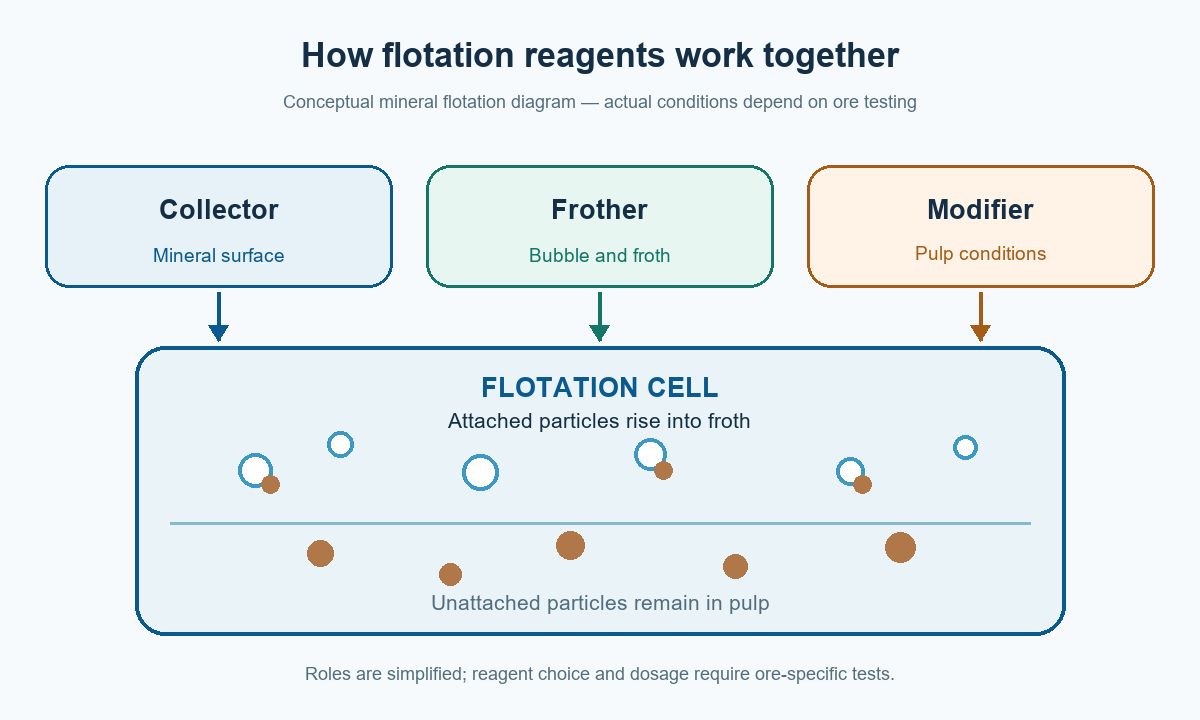
A common simplified sequence is ore and water → conditioning and reagent addition → air-bubble contact → froth recovery. Actual addition points, order, dosage and residence time depend on the ore and plant; they should not be copied from a generic diagram. See the separate flotation reagent regime guide for that operational topic.
What are the three main functions?
Collectors, frothers and modifiers are useful first-level categories. Their effects interact, so a plant evaluates the reagent system rather than selecting each chemical in isolation.
| Function | Where it acts | What it changes | Example to investigate |
|---|---|---|---|
| Collector | Mineral–water interface | Promotes attachment of selected mineral particles to bubbles. | Sodium butyl xanthate for an appropriate sulfide-ore test. |
| Frother | Air–water interface | Influences bubble formation, froth stability and drainage. | MIBC frother where its froth characteristics suit the circuit. |
| Modifier | Pulp chemistry or mineral surface | Adjusts conditions such as pH, activation or depression to influence selectivity. | pH regulator, activator or depressant chosen for the ore. |
Flocculants used for thickening or tailings-water clarification may be part of the wider mineral-processing chemical system, but they should not automatically be treated as a substitute for a collector, frother or flotation modifier. The types guide compares the chemical families in more detail.
Why are flotation reagents needed?
Valuable and unwanted minerals may not have a large enough natural difference in floatability for a useful separation. Reagents can increase the contrast, but the result depends on mineralogy, oxidation, particle size, water chemistry, pH and the full flowsheet. More chemical is not necessarily better: excess collector or frother can worsen selectivity or froth behavior. Recovery and concentrate grade must be considered together, not promised from a reagent name alone.
A simple sulfide-ore example
Illustrative scenario, not a tested YuXing plant result: a metallurgist wants to recover a target sulfide mineral while limiting unwanted minerals in the concentrate. Bench tests may compare a suitable collector, a frother and a modifier regime. The team measures recovery, concentrate grade and froth behavior under controlled conditions, then checks whether changing one reagent improves the target without creating another problem. The correct choice can differ even between deposits of the same metal.
This is why a question such as “Which flotation reagent is best?” cannot be answered responsibly without the ore and performance target.
How to evaluate a flotation reagent system
A useful reagent screen changes one controlled variable at a time before the best candidates are combined. The table below is an illustrative test plan, not YuXing plant data or a dosing recommendation. Use the same representative ore, grind, water, pulp density and flotation time so that reagent effects can be compared fairly.
| Test stage | Variable to compare | Keep constant | Record |
|---|---|---|---|
| Baseline | Current plant or laboratory scheme | Ore, grind, water, pH and air rate | Recovery, concentrate grade, mass pull and froth observations |
| Collector screen | Collector chemistry and active dosage | Frother and modifier conditions | Target-mineral recovery and unwanted-mineral recovery |
| Frother screen | Frother type and dosage | Selected collector and pulp chemistry | Bubble/froth behavior, drainage, entrainment and recovery |
| Modifier or pH screen | Activator, depressant or pH condition | Selected collector/frother pair | Selectivity, grade and reagent consumption |
| Confirmation | Best combined candidates | Representative process conditions | Repeatability and the plant KPI that matters to the circuit |
For example, a sulfide-ore program may screen a xanthate collector with an MIBC frother and, where mineralogy supports it, an activator such as copper sulfate pentahydrate. Suitability, addition order and dosage must be confirmed by a qualified metallurgist. YuXing’s mining and mineral processing supply page explains the product and document information buyers can provide for an inquiry.
What information is needed before choosing a reagent?
- Ore type, target minerals and important unwanted minerals.
- Current grinding fineness, water quality, pH range and reagent regime.
- The measured problem: recovery, concentrate grade, froth behavior or selectivity.
- Bench or plant-trial results, if available.
- For procurement: product grade, quantity, destination, packaging and required TDS/SDS/COA.
For product comparisons, start with the reagent-types guide; for available product families, browse YuXing mining chemicals. Buyers can send their process requirements through the inquiry page. Supply, documents and suitability must be confirmed for the proposed product and order.
Frequently asked questions
Are collectors and frothers the same thing?
No. A collector primarily changes how a selected mineral surface interacts with water and bubbles. A frother primarily influences bubbles and the froth that transports attached particles.
Is one flotation reagent suitable for every ore?
No. Mineralogy and surface condition, water chemistry, pH and the separation target affect performance. Reagent selection requires ore-specific tests.
Does a higher reagent dosage always improve recovery?
No. Excess dosage can reduce selectivity or make froth harder to control. Test dosage alongside concentrate grade and recovery.
What is the difference between this article and the types guide?
This article explains what flotation reagents do and how they work together. The types guide covers collector, frother and modifier families in greater detail.
Technical source and scope
The functional explanation is informed by Orica Mining Chemicals’ Flotation Guidebook (published 2009). It is a general technical reference, not current product availability, a YuXing test report, a safety data sheet or an ore-specific operating recommendation. Consult current product documents and qualified site personnel before plant trials.
nTechnical review: YuXing Chemical product and application team. Reviewed October 9, 2026. Scope: flotation-reagent functions, test logic and procurement information; this review does not replace ore-specific metallurgical testing or site safety procedures.
