A common way to use PAC and PAM together is to dose polyaluminium chloride (PAC) for coagulation, then add a suitable polyacrylamide (PAM) flocculant at a separately controlled point. Confirm the grade, dose, sequence and mixing conditions by jar testing with representative water before a controlled plant trial. There is no universal PAC:PAM ratio or mandatory delay that suits every treatment system.
Here, PAC means polyaluminium chloride, also written polyaluminum chloride—not powdered activated carbon. This guide covers coagulation–flocculation for water clarification; it is not a substitute for an engineered operating procedure or a drinking-water approval.
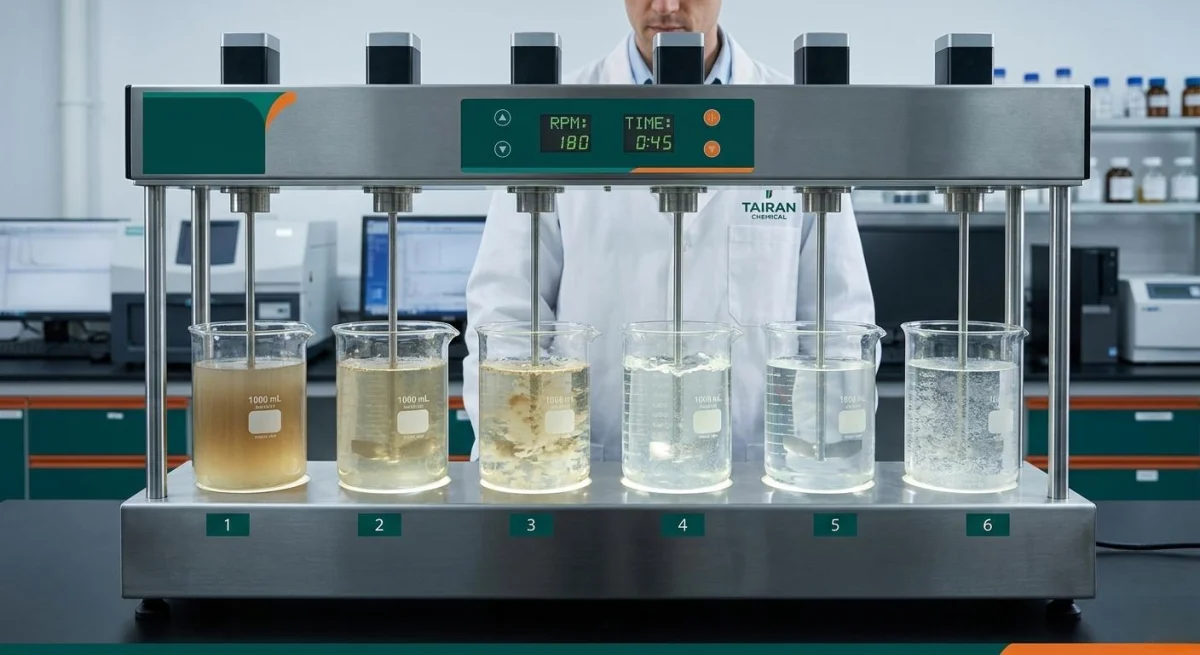
PAC vs PAM: different roles in water treatment
| Chemical | Main role in this treatment approach | Selection considerations |
|---|---|---|
| Polyaluminium chloride (PAC) | Inorganic coagulant that helps destabilize suspended or colloidal material; the mechanism depends on water chemistry and treatment conditions. | Product form, declared aluminium content and reporting basis, basicity, raw-water pH and alkalinity. |
| Polyacrylamide (PAM) | Polymer that can assist floc formation and strength, including particle bridging with a suitable grade. | Charge type, charge characteristics, molecular structure, preparation quality and separation equipment. |
The objective is an effective treatment system, not simply the largest visible floc. Evaluate clarified-water quality, separation behavior, sludge handling and downstream requirements together. Adding a polymer is not automatically necessary when a coagulant-only treatment already meets the relevant targets.
PAC and PAM dosing order: a practical starting workflow
1. Characterize the incoming water and prepare the chemicals separately
Record the source, sampling time, temperature, turbidity or suspended solids, pH and alkalinity where relevant. Check the current product specifications and SDS. Use separate preparation and metering systems appropriate to each product. Do not combine concentrated PAC and PAM stocks in one tank unless the supplier has specifically validated that formulation and equipment arrangement.
Powder PAM needs controlled wetting and hydration according to its grade-specific instructions. Emulsion products require a different preparation procedure. See our powder PAM solution preparation guide; do not apply one stock concentration or hydration time to all products.
2. Disperse PAC at the selected coagulation point
In a conventional PAC-first approach, provide mixing that distributes the coagulant effectively. Check pH and alkalinity response as well as water clarity. Determine the dose and mixing conditions by testing rather than adopting a fixed pH range, mixer RPM or contact time from another plant.
3. Add the selected PAM at a separately controlled point
Test polymer addition after coagulant dispersion and compare an appropriate lower-shear flocculation stage. Sufficient distribution is still necessary; excessively weak mixing can also give poor results. The injection location and delay depend on the equipment, hydraulics, water and grade—not a compulsory one-to-three-minute rule.
Do not assume that PAC always requires anionic PAM, or that cationic PAM cannot work. Screen suitable charge types against the actual water and treatment objective. Our anionic vs cationic polyacrylamide guide explains the selection distinction.
4. Separate the flocs using the intended process
In sedimentation, settleable flocs move toward the sludge collection zone. In dissolved air flotation (DAF), bubbles carry conditioned solids toward the surface for removal. These are different separation mechanisms. A settling-jar result alone does not establish DAF performance, and clarification sludge is not automatically a dewatered cake.
Clear-looking water is not proof that all dissolved contaminants have been removed or that reuse or discharge requirements are met. Apply the required downstream treatment and analytical checks.
How to determine the PAC and PAM dosage by jar testing
Use representative samples and a documented procedure that approximates relevant plant mixing and separation conditions. Keep jar volume, sampling depth and observation times consistent. The following comparison plan is a starting framework, not a numerical dosing prescription.
- Establish controls: include untreated water and the current operating treatment where applicable.
- Screen coagulation: compare PAC conditions and record pH, water quality and separation response before attributing every problem to PAM.
- Compare polymer grades and doses: test suitable PAM candidates with promising PAC conditions. Refine the combined treatment because interactions can change the result.
- Check the addition arrangement: compare injection sequence, interval and mixing without changing every variable at once.
- Assess the complete result: record clarified-water turbidity or suspended solids, floc behavior, sludge volume and relevant filtration or DAF performance.
- Validate robustness: repeat with meaningful feed-water changes and then perform an authorized, controlled plant trial.
Keep dose units and active content consistent
A dose stated as commercial PAC product is not the same as a dose stated as Al₂O₃ or aluminium. Likewise, commercial PAM mass and active-polymer mass are not interchangeable. Record the stock preparation, product basis and active content before comparing ratios or costs.
Arithmetic example only: a stock containing 1 mg of the stated material per mL, dosed at 2 mL into a 1 L sample, gives 2 mg/L on that same material basis. This demonstrates unit conversion; it does not recommend a PAC or PAM treatment dose. For plant metering, convert using the actual flow, stock concentration and calibrated delivery.
For PAM product-consumption and prepared-solution flow calculations, see the polyacrylamide dosage calculation guide. Keep the product-mass and active-polymer bases explicit; the worked examples do not determine the treatment dose or the PAC:PAM ratio for your water.
Troubleshooting PAC and PAM treatment
| Observation | Possible checks | Next comparison |
|---|---|---|
| Cloudy water and little floc | Feed-water change, PAC condition, pH or alkalinity, PAM selection and chemical delivery | Re-establish a coagulation baseline, then compare polymer candidates. |
| Flocs form but break downstream | Mixing energy, pumping or transfer shear, polymer preparation | Compare injection location and handling alongside grade and dose. |
| Sticky deposits or polymer lumps | Powder wetting, hydration, stock concentration, injection distribution and possible excessive dosing | Correct preparation and metering before simply increasing dosage. |
| Clear overflow but difficult sludge | Sludge concentration, volume, handling and dewatering response | Compare water quality and sludge performance together. |
| Higher chemical consumption | Dose basis, pump calibration, feed variation, product concentration and treatment targets | Compare total treatment cost at equivalent verified performance. |
Handling and application limits
Follow the current SDS for each supplied grade, including personal protection, compatible equipment, storage and spill response. Polymer spills can create a slipping hazard. Drinking-water and other sensitive uses require an appropriate product grade and verification of applicable approvals and residual limits; an industrial grade should not be assumed suitable.
Frequently asked questions
Should PAC or PAM be added first?
PAC-first followed by a separately dosed PAM flocculant is a common starting approach for coagulation–flocculation. Confirm the sequence and injection points by testing; it is not a universal rule for every polymer or process.
Can PAC and PAM be mixed in the same preparation tank?
Do not combine concentrated stocks unless the supplier has validated the specific formulation and preparation arrangement. Separate preparation and controlled dosing allow the two chemicals to be evaluated and adjusted independently.
What is the best PAC to PAM ratio?
There is no universal ratio. Define the PAC product or aluminium basis and PAM active-polymer basis, then compare combinations against the actual water and separation targets.
How long should the delay between PAC and PAM addition be?
Determine it from the chemical response, mixing, injection points and plant hydraulics. Do not impose a fixed delay without testing it under representative conditions.
Does PAC always need anionic PAM?
No. Suitable charge type and grade depend on the water and treatment objective. Compare justified candidates rather than assuming the coagulant name alone determines polymer selection.
Will adding PAM always reduce treatment cost?
No. Compare chemical consumption, clarified-water quality, sludge handling and downstream costs at equivalent performance. Savings depend on the application and should not be promised as a fixed percentage.
Technical references
- EPA Ireland: Water Treatment Manuals—Coagulation, Flocculation & Clarification (2002): background on coagulation, clarification and jar-test control.
- US EPA: LT1 Turbidity Provisions Technical Guidance Manual (2004): jar-testing and plant-condition considerations.
These are background technical references, not current product certificates, regulatory approval for a particular use or evidence of YuXing field results.
Discuss a PAC and PAM supply requirement
Send the application, water conditions, current grade, dose basis, trial observations, quantity and destination through our contact page. Review our water treatment chemicals, PAC and PAM product information, and confirm available specifications and document scope before ordering.