To calculate polyacrylamide dosage, first identify whether the trial dose is expressed as mg of active polymer per litre of water or kg of active polymer per tonne of dry solids. Calculate active polymer demand, convert it to commercial product consumption, and then calculate the flow of the prepared dosing solution. These are three different quantities.
This guide covers water-treatment dosing in mg/L, sludge-dewatering dosing in kg/t DS, powder and emulsion consumption, and dosing-pump flow in L/h. All example doses and product properties below are assumed calculation inputs, not recommended operating doses or YuXing product specifications.
Units and concentration basis · Core formulas · Worked examples · Common errors · FAQ
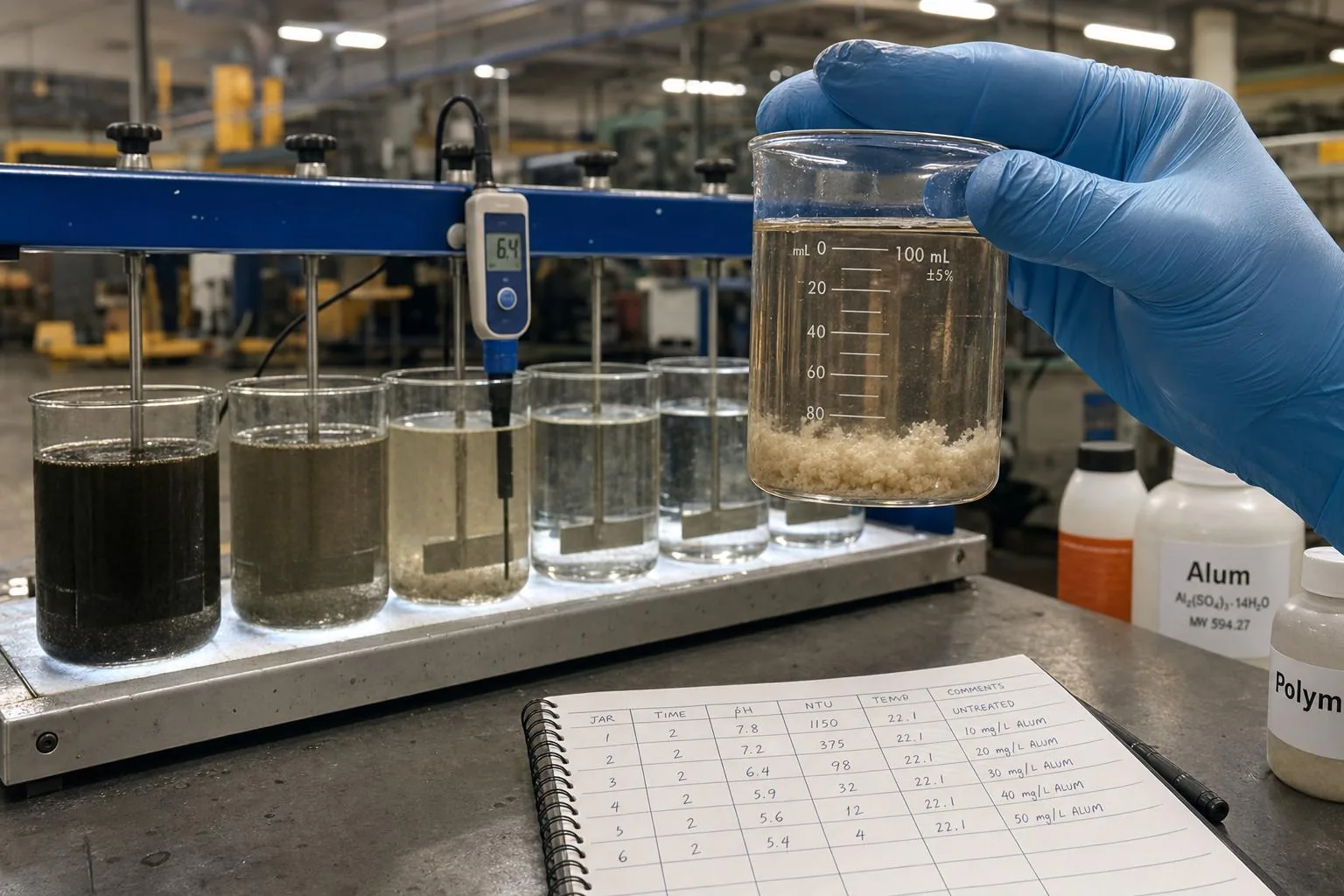
Before calculating: define the dose and concentration basis
| Quantity | Meaning | Example |
|---|---|---|
| Active dose, mg/L | Active polymer mass per volume of treated water | 3 mg/L = 3 g/m³ |
| Specific dose, kg active/t DS | Active polymer mass per metric tonne of dry solids | 5 kg active/t DS = 5 g active/kg DS |
| Product active fraction, f | Confirmed active polymer mass divided by commercial product mass | 90% → f = 0.90; 40% → f = 0.40 |
| Prepared-solution concentration, C | Active polymer mass per litre of final solution | 0.2% active w/v = 2 g/L = 0.002 kg/L |
| Solids concentration | Dry-solids mass per slurry volume, or a stated mass fraction with density | 20 kg DS/m³; alternatively 2% w/w at 1,000 kg/m³ |
Use a supplier-confirmed active-content basis. Total solids, dry matter and active polymer are not automatically interchangeable. If a trial dose is already stated as commercial product mass, do not divide it by the active fraction again. In dilute water with density near 1 kg/L, ppm by mass is approximately equal to mg/L; use mg/L explicitly in these calculations.
Core polyacrylamide dosage formulas
Use Q for water or sludge flow in m³/h, D for water-treatment dose in mg active/L, f for the product active mass fraction, and ρ for liquid-product density in kg/L.
From water flow to product consumption
Active polymer (kg/h) = Q × D ÷ 1,000
Commercial product (kg/h) = active polymer (kg/h) ÷ f
Liquid product (L/h) = commercial product (kg/h) ÷ ρ
The liquid-product result describes neat emulsion or another liquid commercial product. It does not describe the flow of the diluted solution delivered to the process.
From sludge dry-solids load to polymer demand
Dry-solids load (t DS/h) = Q × solids concentration (kg DS/m³) ÷ 1,000
Active polymer (kg/h) = dry-solids load (t DS/h) × specific dose (kg active/t DS)
If solids are measured as a mass fraction instead, calculate dry-solids load in kg/h as Q × sludge density (kg/m³) × solids mass fraction. For example, 2% w/w is 0.02, not 2. Use measured density when a water-like approximation is unsuitable. Published sludge-dewatering research likewise relates polymer flow to sludge flow, dry-solids content and polymer concentration.
From active demand to prepared-solution pump flow
Prepared-solution flow (L/h) = active polymer demand (kg/h) ÷ C (kg active/L)
Pump flow (mL/min) = solution flow (L/h) × 1,000 ÷ 60
For a concentration of x% active w/v, C = x ÷ 100 kg/L: 0.2% becomes 0.002 kg/L. For x% active w/w, C = (x ÷ 100) × solution density (kg/L). A solution made with 0.2% commercial powder is not necessarily 0.2% active polymer.
Three worked dosage calculations
Example 1: water clarification, mg/L to powder consumption
Assume a water flow of 200 m³/h, a trial-selected dose of 3 mg active/L, and a powder with confirmed active fraction f = 0.90.
- Active demand = 200 × 3 ÷ 1,000 = 0.60 kg/h.
- Powder consumption = 0.60 ÷ 0.90 = 0.667 kg/h.
- For 24 hours at these conditions: 0.667 × 24 ≈ 16.0 kg of commercial powder/day, using the unrounded hourly value.
If flow changes to 300 m³/h while the validated dose remains 3 mg/L, powder demand becomes 1.00 kg/h. Recheck the dose if water quality changes; a flow calculation alone cannot determine the optimum dose.
Example 2: sludge dewatering, kg/t DS to powder or emulsion consumption
Assume sludge flow of 20 m³/h, solids of 20 kg DS/m³, and a trial-selected dose of 5 kg active/t DS.
- Dry-solids load = 20 × 20 ÷ 1,000 = 0.40 t DS/h.
- Active polymer demand = 0.40 × 5 = 2.00 kg/h.
- At f = 0.90, powder consumption = 2.00 ÷ 0.90 ≈ 2.22 kg/h.
- Alternatively, at f = 0.40 and emulsion density 1.05 kg/L, emulsion consumption = 2.00 ÷ 0.40 ÷ 1.05 ≈ 4.76 L/h.
These alternative product calculations use the same assumed active demand; they do not establish equivalent treatment performance between grades. The dose corresponds to 100 mg active/L of this particular sludge feed: 5 × 20 = 100. It is not a universal dewatering dose.
Example 3: solution preparation and dosing-pump flow
Use the 2.00 kg active/h demand from Example 2 and a final solution containing 0.2% active polymer w/v, equivalent to 0.002 kg active/L.
- Prepared-solution pump flow = 2.00 ÷ 0.002 = 1,000 L/h.
- This is approximately 16,667 mL/min; it is a different flow from the 4.76 L/h neat-emulsion feed.
- A 1,000 L final batch contains 2.00 kg active polymer. At f = 0.90, use approximately 2.22 kg of powder and make up to 1,000 L final solution volume.
Follow the grade-specific preparation and maturation instructions; this arithmetic does not establish a suitable make-up concentration or preparation method. Confirm preparation-unit capacity and calibrate delivered flow under representative operating conditions. For preparation steps, see how to prepare a PAM solution.
Common polymer-dosing calculation errors
- Entering 90 instead of 0.90: active fractions in these formulas are decimals.
- Confusing product and active dose: label every trial result and concentration with its basis.
- Using mg/L without sludge solids: record kg active/t DS for solids-based comparisons; distinguish total dry solids from TSS measurements.
- Treating batch volume as water addition: make up to the final solution volume, rather than adding that full volume of water to the product.
- Equating a calculated dose with an optimum dose: confirm grade and dose through suitable laboratory trials and plant verification, assessing separation, solids capture and dewatering performance.
There is no single PAM dose valid for every water or sludge. Changes in solids characteristics, charge demand, mixing, preparation and equipment can change the required dose. See anionic versus cationic PAM selection and PAM troubleshooting for the related selection and diagnostic steps.
FAQ
How do I calculate polyacrylamide dosage in kg/h?
For a dose expressed as mg active/L, multiply water flow in m³/h by the dose and divide by 1,000. This gives kg active/h. Divide by the confirmed product active fraction to obtain kg of commercial product per hour.
How do I convert kg active/t DS to mg active/L?
Multiply kg active/t DS by solids concentration in kg DS/m³. For example, 5 kg active/t DS at 20 kg DS/m³ equals 100 mg active/L. The conversion applies to that feed-solids concentration.
Is a 0.2% PAM solution always 2 g of active polymer per litre?
Only if 0.2% is defined as active polymer w/v. A 0.2% commercial-product w/v solution contains 2 g of product per litre; at 90% active content, it contains 1.8 g active/L. A w/w concentration also requires solution density to convert to g/L.
Does the calculated emulsion flow equal the dosing-pump flow?
Not necessarily. Neat-emulsion feed is calculated from product active content and product density. The prepared-solution dosing pump is calculated from active demand and the final active concentration of the solution it delivers.
Information to include when requesting a PAM grade
Provide the application, water or sludge flow, measured solids concentration, existing trial dose and its basis, preparation conditions, and separation equipment. For available grade information, visit the polyacrylamide product page. Confirm the active-content basis in the offered product documentation before using it in a consumption calculation.