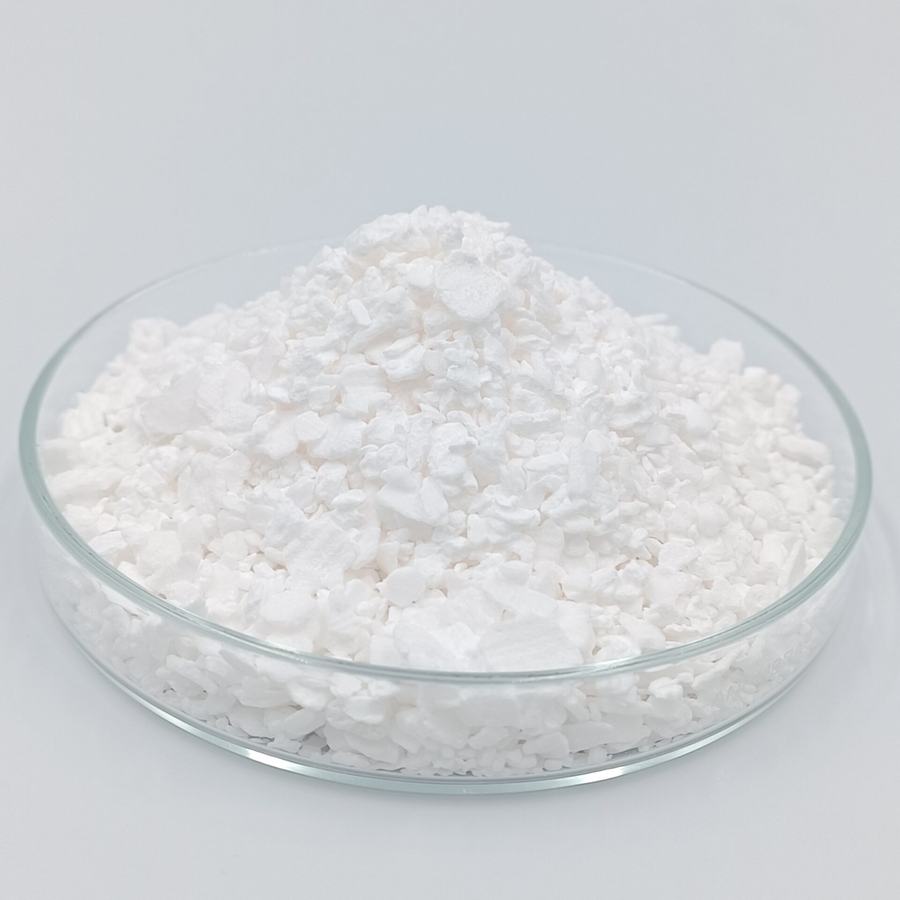
Calcium Chloride Supplier: 74% Flakes & 94% Pellets
- Product Name:
- Calcium Chloride
- CAS No.:
- 10043-52-4 (anhydrous CaCl₂)
- Molecular Formula:
- CaCl₂
- Molecular Weight:
- 110.98 g/mol (anhydrous basis)
- Commercial Grades:
- Typically 74% flakes / 94% pellets or powder
- Appearance:
- White flakes, pellets or powder
Industrial Calcium Chloride Supplier
YuXing supplies industrial calcium chloride in commercial grades such as 74% flakes and 94% pellets or powder for moisture control, process brines, dust control, deicing and compatible construction applications. Grade percentages and physical form must be confirmed against the supplier specification and batch COA because commercial calcium chloride can contain different amounts of water and other constituents.
The CAS number 10043-52-4, formula CaCl₂ and molecular weight 110.98 g/mol describe anhydrous calcium chloride. A 74% commercial flake is not chemically identical in composition to a 94% product simply because both are sold as “calcium chloride.” State the required assay, form, impurity limits, application, packaging and destination when requesting a quotation.
Calcium Chloride Procurement Snapshot
| Item | Typical supply option | Buyer confirmation |
|---|---|---|
| Chemical identity | Calcium chloride; CaCl₂; CAS 10043-52-4 on anhydrous basis | Confirm grade, hydration/water basis and applicable standard |
| Commercial grades | Commonly 74% flakes and 94% pellets or powder | Confirm assay and impurity limits by specification and COA |
| Physical form | Flakes, pellets, granules or powder depending on source | Specify feeding, dissolution, dust and handling requirements |
| Packaging | 25 kg moisture-resistant bags or jumbo bags may be available | Confirm liner, palletization, net weight and container loading |
| Documents | TDS, SDS and batch COA can be coordinated for the confirmed product | Request application- or destination-specific documents before quotation |
74% vs 94% Calcium Chloride
| Selection factor | 74% calcium chloride | 94% calcium chloride |
|---|---|---|
| Common form | Often supplied as flakes | Often supplied as pellets, granules or powder |
| Active CaCl₂ basis | Lower active content per tonne | Higher active content per tonne |
| Handling | Hygroscopic; confirm caking, storage and dissolution behavior | Also highly hygroscopic; requires moisture-resistant packaging and sealed storage |
| Process choice | May suit applications designed around flake handling and the confirmed solution concentration | May suit applications seeking higher active content and lower freight per unit of CaCl₂ |
| Final decision | Compare delivered active cost, dissolution, impurities, equipment compatibility, storage and the required application specification | |
“74%” and “94%” are commercial concentration descriptions, not universal guarantees. Suppliers may use different test methods, forms and impurity limits. Evaluate the signed specification and COA rather than choosing on percentage alone.
Specifications to Confirm Before Purchase
| Parameter | Why it matters |
|---|---|
| CaCl₂ assay | Determines delivered active content and solution preparation calculations |
| Total alkali/alkalinity | May affect process compatibility and quality limits |
| Magnesium and other salts | Can influence brine, drying, construction or process performance |
| Water-insoluble matter | Affects solution clarity, filtration and deposits |
| Iron | May matter in color- or contamination-sensitive processes |
| Particle form and size | Influences flow, dust, feeding and dissolution rate |
| Water or hydration basis | Explains the difference between commercial concentrations and anhydrous CaCl₂ |
Industrial Applications and Selection Limits
Moisture control and desiccant use
Calcium chloride is hygroscopic and can absorb moisture, which supports some desiccant and humidity-control uses. The packaging design, exposed surface area, containment and target environment determine performance; open handling also requires controls because the material and concentrated solutions can irritate eyes and skin.
Dust control and road treatment
Calcium chloride is used in some dust-control and snow/ice-control programs. Application rate, climate, pavement or soil, runoff and local environmental requirements must be assessed by the operator. The U.S. Federal Highway Administration describes calcium chloride as a deliquescent dust suppressant and discusses its use in anti-icing/deicing programs.
Process brines and water treatment
Calcium chloride is highly soluble and is used in selected industrial brines and process-water applications. Check the required solution concentration, heat released during dissolution, corrosion risk, impurity limits and compatibility with equipment. For related salts, compare magnesium chloride and sodium chloride.
Construction applications
Some calcium chloride grades are used as set accelerators, but chloride compatibility is a critical engineering issue. Do not assume suitability for reinforced, prestressed or metal-embedded concrete. Follow the project specification, applicable standards and qualified concrete-engineering review.
How to Request the Correct Calcium Chloride Grade
- Required concentration, such as 74% or 94%, and the applicable standard.
- Flake, pellet, granular or powder form and any particle-size requirement.
- Application and critical impurity limits, including insolubles, alkalinity, magnesium or iron where relevant.
- Target solution concentration, dissolution equipment and corrosion/compatibility constraints.
- Packaging, monthly demand, destination port and Incoterm.
- Required TDS/SDS/COA and destination-specific declarations.
Packaging, Storage and Document Support
Calcium chloride is hygroscopic and deliquescent. Keep bags sealed, dry and protected from damaged liners, moisture and incompatible materials. Dissolution can release significant heat, so follow the current SDS, label, controlled addition procedure and site risk assessment.
YuXing can coordinate available TDS, SDS, batch COA, packaging and commercial/shipping documents for the selected grade. Browse inorganic salts and chemicals, the full chemical catalog, or submit a calcium chloride inquiry.
Frequently Asked Questions
What are the CAS number and formula of calcium chloride?
Anhydrous calcium chloride has CAS number 10043-52-4, formula CaCl₂ and molecular weight 110.98 g/mol. Commercial grades may contain water and other constituents, so confirm the assay basis.
What is the difference between 74% and 94% calcium chloride?
The percentage indicates the typical CaCl₂ content on the supplier’s stated basis. A 74% product is often sold as flakes, while a 94% product is commonly supplied as pellets, granules or powder. Confirm the actual specification and COA.
Is calcium chloride the same as sodium chloride?
No. Calcium chloride is CaCl₂ and sodium chloride is NaCl. Their active content, dissolution behavior, hygroscopicity and application performance differ.
Which documents can YuXing coordinate?
TDS, SDS and batch COA can be coordinated for the confirmed manufacturer, grade and order. Other declarations depend on source, application and destination.
What information is needed for a calcium chloride quote?
Provide the required concentration and form, specification, application, quantity, packaging, destination and documents. State whether the price comparison should be based on delivered tonnes or delivered active CaCl₂.
Technical References and Review
- PubChem: Calcium Chloride (CAS 10043-52-4)
- U.S. Federal Highway Administration: Unpaved-road dust-control references
- FHWA: Anti-icing and brine-generation practice
Technical review: YuXing Chemical product and application team. Reviewed October 9, 2026. Final suitability, concentration, test method, packaging and documents must be confirmed for the selected grade and application.
Request a Calcium Chloride Quote
Product Information Notice
- The values shown are typical reference information and are not a guaranteed sales specification. Final specifications are subject to the confirmed product, grade and batch COA.
- Packaging, transport method and hazard classification must be confirmed according to product grade, order quantity, destination regulations, shipping route and the current SDS.
- TDS, SDS/MSDS and COA files are provided according to product, batch and destination requirements. Public documents should not be treated as final delivery documents unless issued for the current batch.
- This page is for procurement discussion and technical selection reference only. It does not replace safety, regulatory, process design or site operating advice. Users must follow local regulations and the latest SDS.
